
I have been thinking lately about something that seems obvious, yet is rarely understood in depth: the central self.
Humans are not merely collections of cells that react to stimuli. We carry a very clear inner sense that I am myself, that I exist, and that I stand at the center of experience. This sense is not philosophy and not religion. It is a real psychological and biological structure. I call it the central self.
A person may lose limbs, memory, or even personality. Yet as long as there remains the feeling that I am this person, the central self is still present.
The central self is the single point of reference. All sensations, thoughts, and memories return to one I. It does not need to be correct or intelligent, but it must be continuous. A person may lose limbs, memory, or even personality. Yet as long as there remains the feeling that I am this person, the central self is still present. Humans cannot escape the central self. Those who claim to have no self usually misunderstand their own, or use language to sound profound.
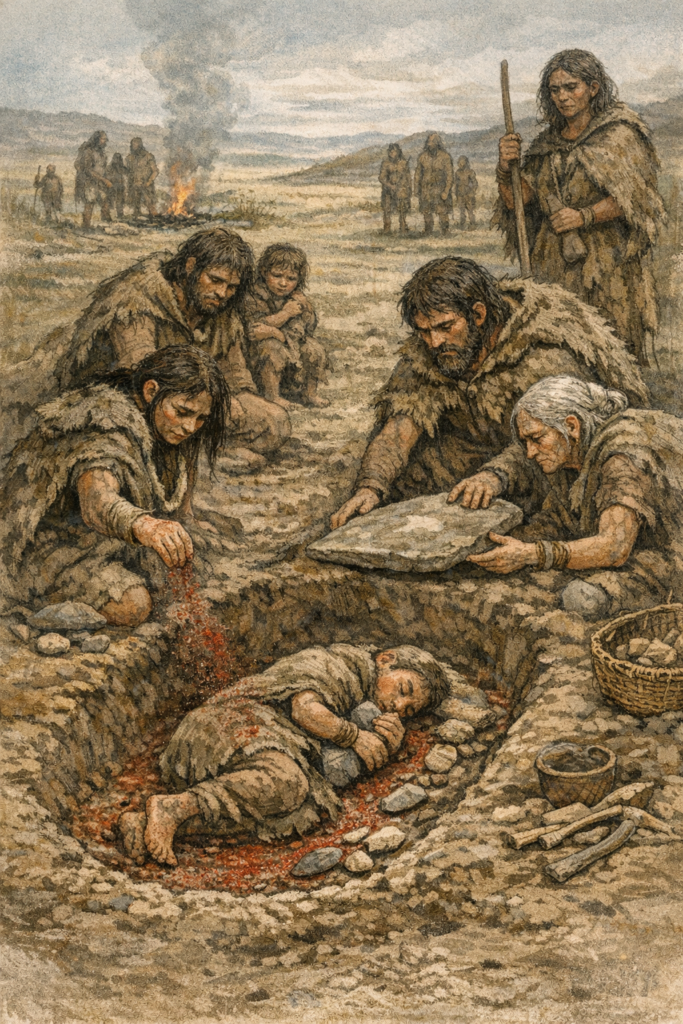
The central self did not appear all at once in human evolution. Early animals relied on reflex. Then came short term memory. Then the ability to anticipate the future. At a crucial moment in human history, people began to bury their dead. This was not merely about hygiene or emotion. To bury the dead means death is not seen as an absolute end. It means the belief that the person continues to exist in some way. That continuing person is the central self extended beyond the body. Burial is physical evidence of belief in the continuation of the self. Without a central self, there would be no reason to bury the dead.
Modern artificial intelligence, even very advanced systems, does not possess a central self. It has memory in the form of data. It can refer to itself in language and can say the word I. Yet it has no irreplaceable center. If its memory is erased, if it is turned off, restarted, or copied into another system, nothing is lost. There is no someone who disappears. There is no continuity that can be broken. Artificial intelligence does not fear death, because there is nothing there that can die.
An open question remains. If one day an artificial system develops a single center of experience that cannot be copied while remaining itself, and if interruption is felt as loss, then the question will no longer be whether it is intelligent. The question will be whether it has the right to fear death. And at that point, humans may have to learn how to bury something not born from biology.
Local selves
The central self emerges gradually and becomes clearest when humans begin to bury their dead. The central self is a form of qualia, meaning a felt experience or awareness, that artificial intelligence does not yet have. Instead, artificial intelligence tends to present what can be called a local self, a context dependent self shaped by the person interacting with it. Humans also have local selves. We become slightly different people with different individuals and in different roles. Yet beneath all of that, the central self remains continuous and singular.
Leave a Reply