AGENT’s FREE WILL
I think the free will debate becomes much clearer if we start with emergence.
An emergent thing is not somehow less real simply because it is made of smaller things. A house exists even though it is made of bricks, concrete, steel, and countless smaller particles. We do not say that the house does not exist because only the bricks are fundamental. The house exists as a higher level of organization, with its own properties and behavior. In the same way, an agent can be an emergent system. The fact that an agent is made of neurons, molecules, atoms, and quantum processes does not make the agent disappear. The agent is the organized system itself.
Once we accept that, I think we should stop asking which individual particle “made the decision.” That question is often asking the wrong level of description. If I ask who walked across the room, the answer is the person, not one particular neuron, muscle fiber, or molecule. Those things are parts of the causal process through which the person acts. The person is still the agent.
Now consider a physicist performing a Young’s double slit experiment. Instead of defining the agent as only the physicist, imagine that the agent is the physicist together with the experimental apparatus and the relevant environment. The apparatus is physically interacting with the physicist, the physicist is interacting with the apparatus, and quantum events occurring within this entire system can affect what happens next. A different quantum outcome can produce a different physical state of the system, which can then lead to different observations, different thoughts, different actions, and ultimately different behavior by the agent.
This is important because it gives us a possible sense in which the agent could have acted otherwise. We do not need to imagine that some mysterious soul stepped outside physics and overrode causality. The agent itself is a physical emergent system. If the physical evolution of that system contains genuine quantum indeterminacy, then rewinding the history and allowing a different quantum outcome can, in principle, lead the same agent down a different trajectory. The agent does not have to control the quantum event. The quantum event is simply one part of the physical history of the system. What matters is that the resulting change can propagate through the agent and eventually produce a different action by the agent itself.
This idea can also be applied to humans. People sometimes assume that, if quantum mechanics has anything to do with free will, the quantum event must happen directly inside the brain. I do not think that is necessary. The human being is not just a brain floating in isolation. The body and brain form a deeply integrated system. A tiny physical difference anywhere in the body can potentially influence physiological states, neural activity, attention, emotion, perception, or other processes that eventually affect the mind. Biological systems are also capable of amplifying very small differences. We know from nonlinear and chaotic dynamics that microscopic differences can sometimes grow into macroscopic differences. Therefore, if a genuinely indeterministic quantum event somewhere in the organism can propagate through the biological system and eventually influence the mind, then the person’s subsequent decision could be different.
The important point is that I am not saying that quantum randomness itself is free will. Randomness by itself is not an agent and does not make a decision. My claim is different. The quantum event can introduce a physical difference into the history of an agent. That difference can propagate through the agent’s own internal processes. The agent can then think differently, evaluate things differently, and act differently. The agent remains the one who acts. I do not need to identify one particular quantum event and say that this event “chose” for the person. There may be an enormous number of quantum processes occurring throughout the system at any given moment. The meaningful causal description at the agent level is still that the agent thought and chose.
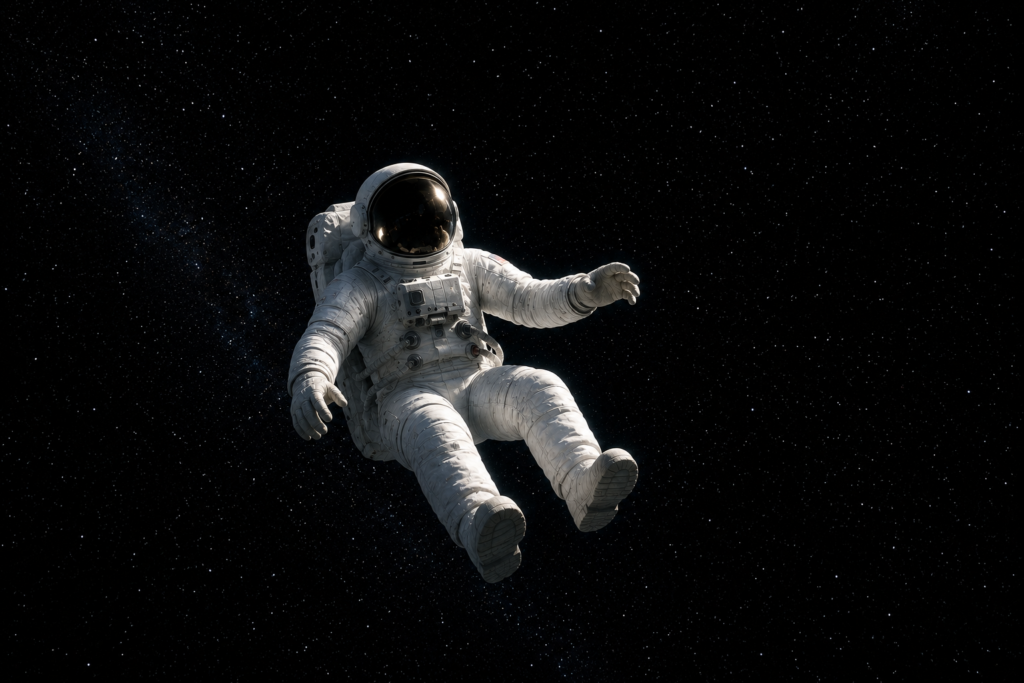
Consider a simple thought experiment. Imagine an astronaut floating alone in space for a month. There is no other person interacting with him and no relevant external information arriving. He has two identical buttons in front of him. One will eventually take him to spacecraft A and the other to spacecraft B. The buttons look exactly the same, and he has no information that gives him a reason to prefer one over the other. Eventually he presses one of them.
Suppose he presses the left button. Who chose it? The answer seems obvious to me. He did. We can describe the decision at a lower level in terms of neurons, neurotransmitters, molecular interactions, electrical activity, and quantum processes, but none of that means that he did not choose. Those processes are the physical processes through which he, as an agent, exists and acts.
Now rewind the universe twenty four hours.
If the universe were perfectly deterministic, with every physical detail exactly reproduced, the astronaut would follow the same trajectory and press the same button. But if quantum events are genuinely indeterministic, the second run does not necessarily have to reproduce every microscopic event in exactly the same way. A different quantum outcome somewhere in the astronaut’s physical system could produce a tiny difference. That difference could be amplified through biological dynamics, alter his physical or mental state, change his thoughts, and eventually lead him to press the other button.
In that case, the same agent has a physically possible alternative trajectory. In one run he chooses A. In another run, a different quantum history propagates through the system, he thinks differently, and he chooses B. The quantum event did not choose B for him. The agent chose B. The quantum indeterminacy simply means that the history leading to the agent’s decision was not uniquely fixed in advance.
This is why I do not think free will needs to be defined as something that exists outside physics or against causality. I also do not think free will has to belong exclusively to humans. If an agent is a real emergent system, then its actions can be genuinely its own actions even though the agent is composed of lower level physical processes. And if the physical world contains genuine indeterminacy that can propagate through an agent and produce different possible trajectories, then that agent can, in this sense, act otherwise.
So my view of free will is not that humans possess some magical ability to violate the laws of physics. It is that agents are real emergent systems, and their actions are real actions of those systems. Quantum indeterminacy can provide alternative physical trajectories, while the agent itself remains the entity that thinks, decides, and acts. The bricks do not need to disappear for the house to exist, and the neurons do not need to disappear for the person to choose.
The scientific question, of course, is still open. We have not demonstrated that quantum indeterminacy actually propagates through a human organism strongly enough to produce different conscious decisions. That part remains a hypothesis. But I think the basic possibility is scientifically meaningful and philosophically worth taking seriously. The question is not whether a quantum particle makes a choice instead of us. The question is whether an emergent agent, as a physical system, can have genuinely different possible futures and still be the entity that chooses in each of them.
I think the answer can be yes.
Leave a Reply