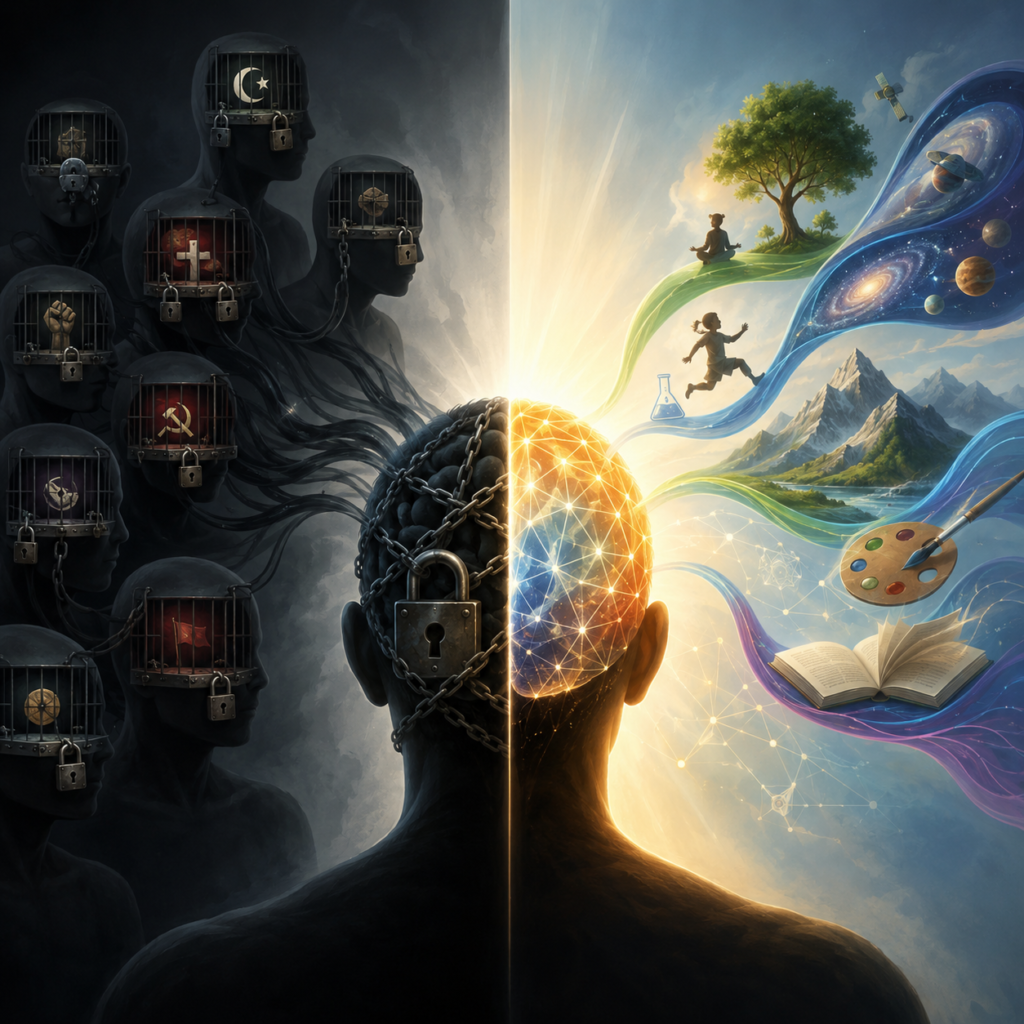
In this part, I’ll discuss several important ideas about models (worldviews) that I didn’t cover in the previous section.
The human brain must have a model in order to function. This is quite similar to a computer—even hardware as powerful as the brain still needs some kind of software to run. So you can’t really say, “I don’t follow any model.” You can only say that you follow a model you built yourself—a model that may not even have a name yet.
Your model also largely determines what you will be able to “know” next. Things that fit your existing model are much easier for your brain to accept and naturally produce the feeling that they are reasonable and correct. In addition, ideas that are completely new relative to your model—ideas for which your model has no framework to describe or evaluate—will, by default, be treated by your brain as true, no matter how false they match the objective evidence.
In the previous part, I defined a model as “a set of memes.” So what is a meme? A meme is a neural structure in the brain—the thing you experience as truth and falsehood, feelings, knowledge, memories, and so on. A set of memes contains countless smaller sets of memes, and each of those, in turn, contains countless other memes.
What counts as right or wrong
When it comes to right and wrong, what counts as right or wrong depends on the model in your brain. It is grounded in some core premise. For example, if someone believes that God exists (God as they personally conceive of Him), then their sense of right and wrong is based on what they believe to be God’s words. If another person does not believe in God, then their standard of right and wrong is based on something else.
The interesting part is that the human brain operates very logically, much like a computer. This is true of every brain, including those of people who have no idea what formal logic even is. Once you know how a person judges right and wrong, you can often identify their underlying model—and the core principle that defines right and wrong for them—very quickly. I usually recognize this within a few seconds, even before the person has finished speaking.
Compartmentalization of the mind
That said, the brain also has a mechanism for bypassing logic. It’s called compartmentalization—the separation of different mental domains.
A person can be highly intelligent, highly logical, and exceptionally skilled in one or many areas, yet in other areas they can be completely blind to obvious contradictions and irrationalities. This mechanism exists because it improves an individual’s chances of survival, and it also explains why intelligent people can still believe irrational things.
Groups also have models of their own, and those models often contain very little genuine reasoning and are instead built upon irrational assumptions. If an individual recognizes this and openly points it out, the group may eliminate or ostracize that individual. As a result, the brain simply blinds itself to that particular area, preventing the individual from seeing the inconsistency and thereby increasing their chances of continued survival.
This explains why highly intelligent individuals can sincerely believe extremely irrational things when they are part of a group. Ultimately, it is a mechanism for survival.
Aside from compartmentalization, however, the brain as a whole still operates according to remarkably strict logic.
Leave a Reply