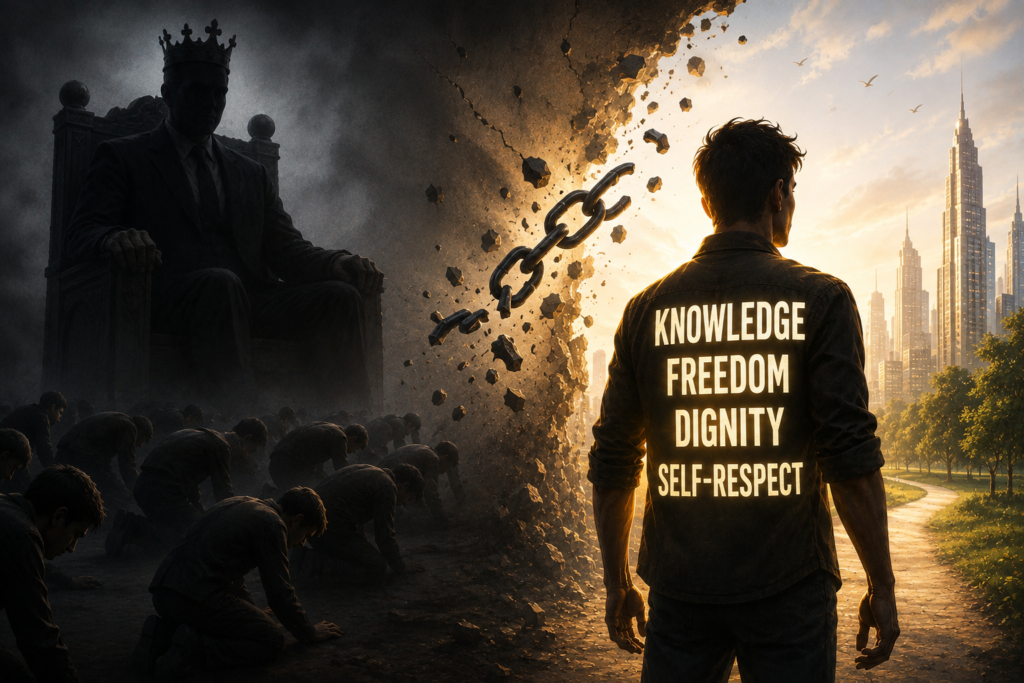
When people stand before power, they often become submissive, intimidated, afraid… This leads to words and actions that strip away their dignity, causing them to lose the respect that every human being deserves.
This fear of power is perhaps a human survival instinct. When facing enormously powerful creatures such as elephants or tigers, running away or bowing before them is a sound survival strategy; charging at them would only lead to death.
Humans then spent roughly 7 million years living in groups. The alpha individuals possessed power comparable to those giant beasts—perhaps even greater—because an alpha could order others to eliminate anyone who opposed them. The human brain came to perceive the alpha as equivalent to those enormous predators, and “bowing” became another survival strategy.
In modern society, the alpha goes by different names: boss, chairman, president, wealthy people… those who hold significant influence over others.
Humans do not only bow before the alpha. We also imagined divine beings with supernatural power. Because we came to believe absolutely that these beings were real, the human brain once again “bowed” to them, just as our ancestors bowed before giant predators millions of years ago.
So, bowing before power has become a human instinct. However, not every instinct should be expressed freely. This particular instinct diminishes us. I believe everyone deserves to live with the full dignity and honor of being human. But how?
They’re all just Homo sapiens
They’re all just human. Each individual simply has a different game, a different model, and a different set of tools. Among these, the tools determine the individual’s level of power.
Take a king, for example. His game is governing a nation; his model (worldview) consists of what he knows and believes; his tools are his soldiers and the millions of people under his command.
But in the end, a king is still just an individual Homo sapiens, belonging to the genus Homo, the family Hominidae, the order Primates, the class Mammalia, the phylum Chordata, the kingdom Animalia, the domain Eukaryota, Life.
Don’t confuse power with an accurate model
When I encounter someone whose model is accurate because of broad knowledge and intelligence, I stop at admiration—I do not worship them. And both of us should respect each other.
One of the main reasons people “bow” is that they assume powerful people must also possess superior models. Sometimes that’s true, but it’s just as often false—about fifty-fifty.
A king’s son remains a king even if he is intellectually impaired or utterly incompetent. A blindly loyal flatterer serving a tyrant can still be promoted. A billionaire’s child may continue to be a billionaire, but that does not mean their model is accurate or that they possess broad knowledge.
Adapt, but do not worship
If there is a tiger in the forest, it is naïve to think that refusing to bow means charging into hand-to-hand combat with it. We may “bow” as a temporary survival ritual, but deep down we must clearly recognize that the tiger is still just an animal.
The same applies within an organization. Fighting the alpha is usually not a good survival strategy. There should be social rituals that allow both sides to communicate respectfully. And if you find yourself in an environment that demands you sacrifice your dignity, you may need to adapt for a while—but ultimately, you must find a way to leave in order to preserve your dignity.
There is a more subtle form still: power in the form of symbols.
A group assigns sacredness to a symbol—an individual, a flag, a scripture, a deity, a value, or almost anything else. Challenging that symbol is then perceived as challenging the power of the entire group. By instinct, most animals (and humans) “bow” before such symbols to avoid being destroyed by the collective force that stands behind them.
Three kinds of power before which humans bow
1. Physical power Tigers, elephants… The brain responds with fear and avoidance.
2. Human power The alpha, the king, the boss, the president… The brain responds with submission because that person can reward or punish.
3. Symbolic power A flag, a throne, a crown, a holy book, a deity, a constitution, a title, even a logo or a value—provided the group is prepared to defend it. The brain does not react merely to the object itself; it reacts to the collective power attached to that object.
“A piece of cloth has no power of its own. But when an entire nation is willing to die to protect it, that piece of cloth becomes a symbol charged with formidable power.”
In other words, a symbol does not possess power; it borrows power from those who believe in it.
All three layers share the same core mechanism: the brain evaluates risk and adjusts behavior to increase the chance of survival.
Leave a Reply